Sound8: A framework for multisensory experiences
“One cue to Systems Intelligence (SI) is to become more sensitive on the channels of input. The senses form an interface with the outer world and if a person wishes to succeed in the context of complex systems and involving interaction and feedback, she needs to be acute on what her senses tell of the world.”
The end of the beginning: beyond "multisensory"
25 topics. 8 senses. Welcome to the GRAND FINALE of The 25 Series. 🥁
I honestly wasn’t sure if my brain would survive mapping out this many connections across a bit over a decade of my knowledge, but here we are!
To give you a bit more context: I’m not the type to just walk into a room and 'vibe.' My brain instinctively starts reverse-engineering the systems architecture behind the experience. From curating unique travel experiences to navigating the complexities of corporate innovation, I have always been driven by an obsession with how systems and people interconnect.
This series has been a subset of all the noise in my head, but it hits on what is one of my actual life missions: curating experiences where the senses are interdependent.
I’ve been geeking out over the fact that most “multisensory” experiences is honestly just a bunch of senses happening at the same time in the same room. You know the drill: You walk into a space, there’s a playlist, some cool lighting, a signature scent, maybe some velvet furniture. It’s all pleasant, and someone clearly spent a lot of money on it.
But here’s the thing: None of it is actually talking to each other.
In most places, the music doesn’t change the scent. The lighting doesn’t care how you’re moving. The textures have zero relationship with the sound. They’re just independent channels running in parallel.
With my engineering heart and my humanities soul, I’m chasing something much deeper. I’m talking about spaces where:
One sensory input directly modifies another.
Your interaction changes the actual logic of what happens next.
The system is so tight that if you removed one sense, the whole thing would fundamentally break.
This finale is my first real go at a “blueprint” for documenting that: a way to bridge the gap between hard tech and human feeling. I want to build worlds where the infrastructure is invisible until it isn’t, and where you aren’t just a guest; you’re a vital part of the feedback loop. The goal is to reveal something about how perception works when the senses are in conversation with each other. To start, every integrated multisensory experience should break down into five parts:
Component — the actual physical thing or designed element
Principle — the science, pattern, or phenomenon it’s built on
Translation — how it connects to and influences other sensory systems
Experience — what you actually perceive when the systems interact
Intended Effect — how it’s supposed to shift your awareness
Let me show you what this looks like using sound as the primary system.
Sound8: An Ode Experience
Sound × Space: The Cori Spezzati Principle

In the 16th century, Basilica di San Marco in Venice had two organ lofts facing each other. Composers started writing music where sound physically moved across the room. They invented “surround sound” or the “stereo” effect.
Component: Multiple sound sources positioned at opposing heights and architectural nodes throughout the space
Principle: Spatial audio and acoustics: sound waves travel at different speeds and intensities depending on distance, material, and positioning
Translation: Different frequency bands (low, mid, high) are routed to specific locations. As the composition unfolds, the sound physically travels through the architecture.
Experience: You walk into an event hall and sound sources are positioned at different heights and angles throughout the architecture. A violin begins behind you. The bass responds from the left wall. You realize the sound is pulling you somewhere. You follow it. The music is organizing the space.
Intended Effect: Sound becomes navigation. You start moving through the composition.
Sound × Sight: The Chladni Geometries
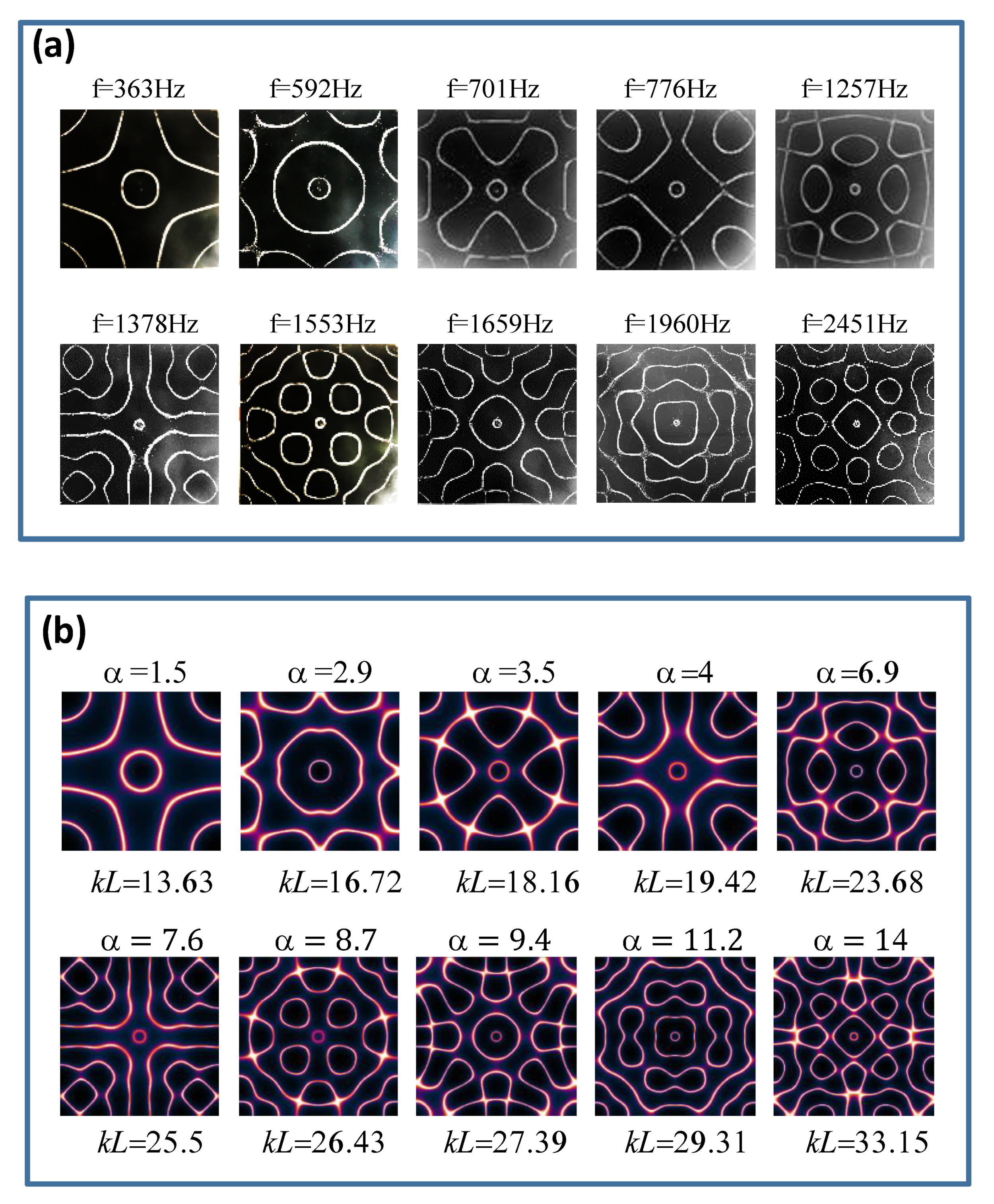
Exploiting Modern Chladni Plates to Analogously Manifest the Point Interaction
In the 1700s, Ernst Chladni discovered that drawing a bow over a metal plate covered in sand creates geometric patterns. Different frequencies, different shapes. He proved sound has physical structure.
Component: Large horizontal plates covered in fine sand or liquid, positioned at acoustic nodes throughout the space
Principle: Cymatics; sound waves create standing wave patterns that physically organize matter
Translation: Real-time visualization where each frequency produces a distinct pattern. High frequencies make intricate, cellular designs. Low frequencies create broader, simpler structures.
Experience: At the check-in table, you watch the sand reorganize itself as the music changes. A low drone creates a mandala. A high-pitched tone shatters it into fractals.
Intended Effect: Sound stops being invisible. You see the density, the complexity, the architecture of what you're hearing.
Sound × Scent: The Odophone Logic
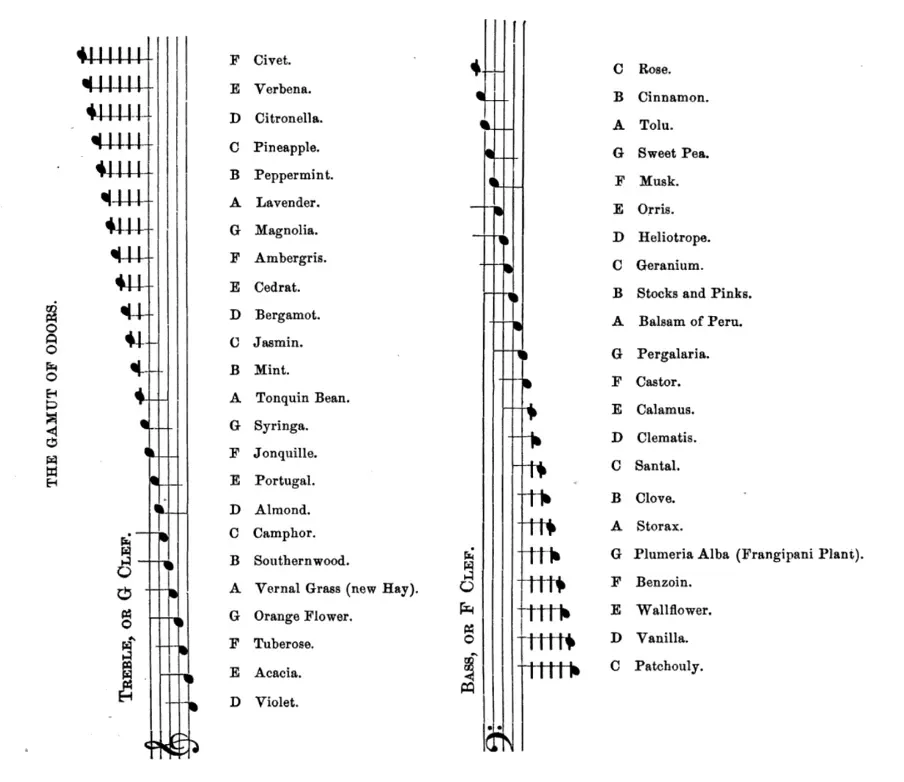
The Art of Perfumery by G.W. Septimus Piesse (1867)
In the 1800s, perfumer Septimus Piesse created a chart mapping scents to musical notes. Sharp, volatile scents like citrus went to high notes. Heavy scents like oud went to low notes. He called it the Odophone.
Component: Controlled ventilation system with scent reservoirs (volatile citrus and eucalyptus, heavy oud and amber) synced to audio frequency bands
Principle: Molecular weight and evaporation rate. Lighter molecules evaporate quickly and hit your nose sharply. Heavier molecules linger and feel grounding.
Translation: Audio analysis detects frequency range. Above 2kHz triggers citrus release. Below 500Hz triggers oud. Volume controls diffusion intensity.
Experience: As the music climbs into higher registers, the air feels sharper, lighter, cooling. When the bass drops, the room becomes warm, dense, almost heavy.
Intended Effect: Scent becomes part of the melody.
Sound × Touch: The Fibonacci Structure
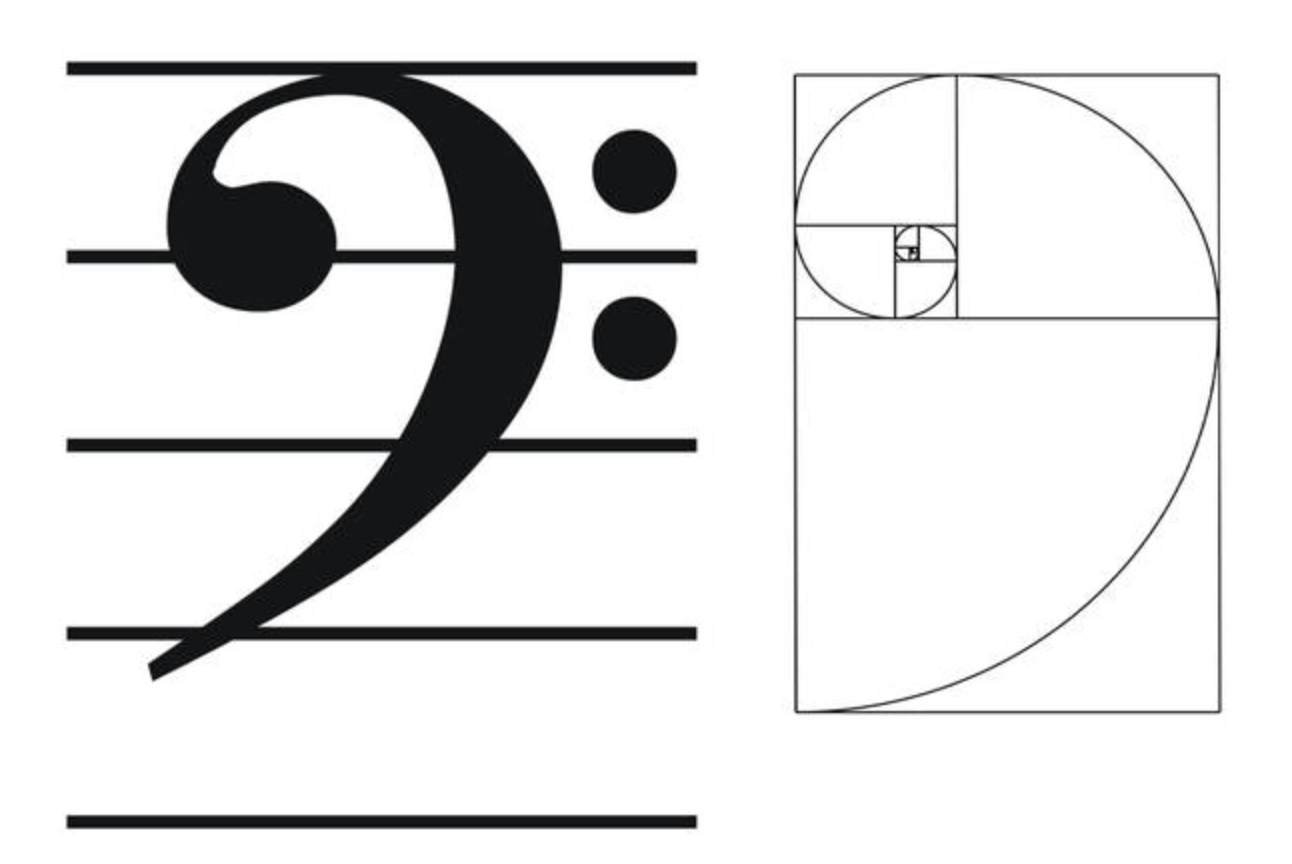
A lot of classical composers (e.g. Bartók) structured pieces around the Golden Ratio (1.618). The climax hits at about 61.8% of the way through. It's a mathematical proportion that shows up everywhere in nature.
Component: Sculptural handrails with surface texture that increases in complexity along their length, designed using Fibonacci proportions
Principle: The Golden Ratio creates a sense of balance that the brain recognizes as "correct" even when you can't explain why
Translation: The roughest, most detailed part of the sculpture is positioned at the physical point corresponding to the temporal max in the music
Experience: Along the walls are sculptural handrails. You run your hand along one. It starts smooth. As the music builds, the texture becomes more intricate
Intended Effect: The abstract structure of music becomes physical. You feel what you're hearing.
Sound × Taste: The Sonic Seasoning Effect
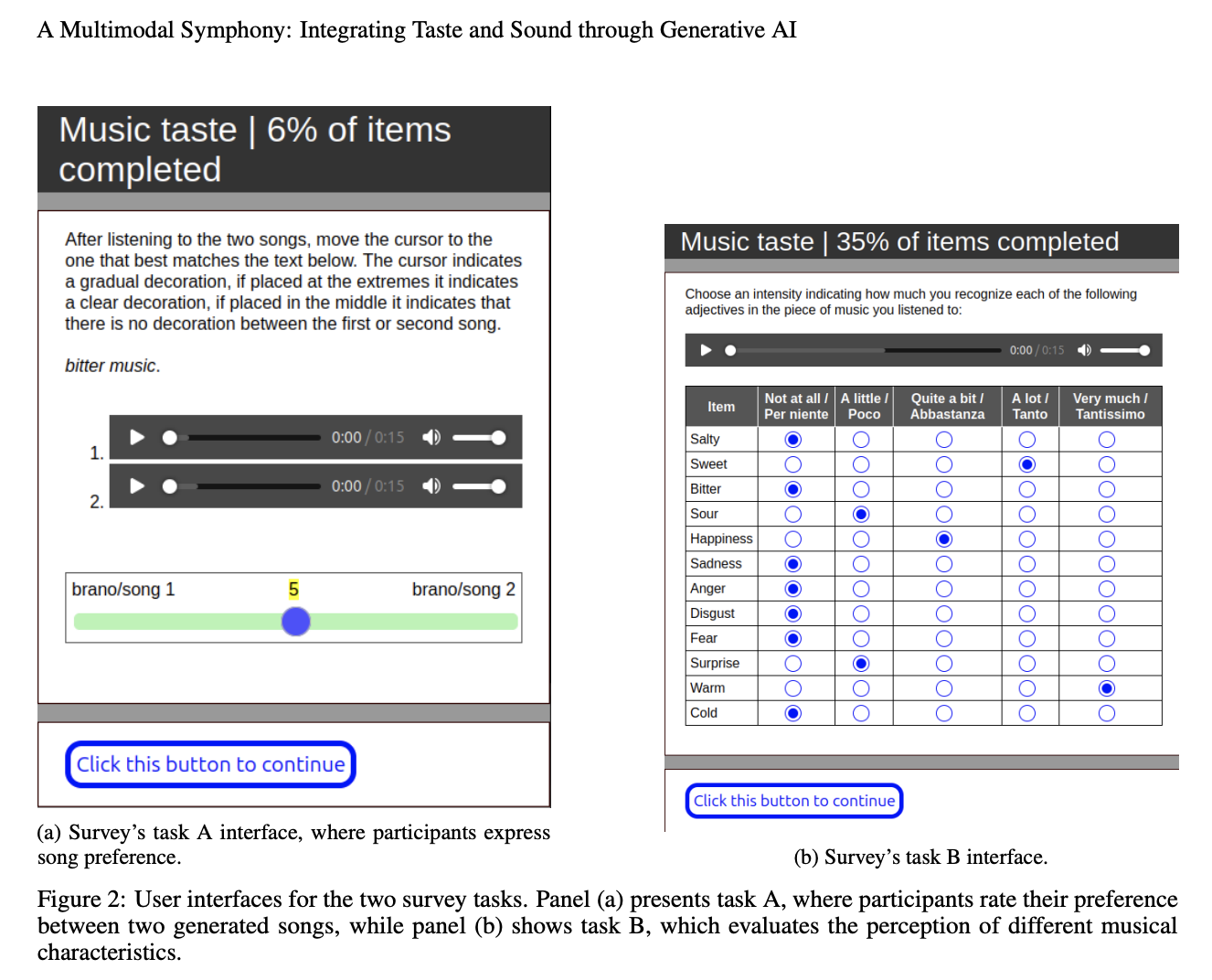
There's this thing called crossmodal correspondence. High-pitched sounds (2000-5000 Hz) make food taste sweeter. Low-pitched sounds (200-500 Hz) make it taste more bitter. It's documented, repeatable, strange. Read previous blog post on this.
Component: Bone-conduction headphones playing frequency-specific audio while you taste curated samples
Principle: The brain maps sensory qualities across different systems. Sharp, high-frequency sounds and sweet tastes both register as "bright" in neural processing.
Translation: As the audio frequency changes, your perception of the same food changes with it.
Experience: You eat a piece of dark chocolate. Low brass tones play; suddenly it tastes earthier, almost like soil in a good way. The frequency shifts to high piano notes. Same chocolate, but now it's brighter, almost floral.
Intended Effect: You realize taste isn't isolated to your tongue. It's being constructed between your mouth, your ear, and your expectation.
Sound × Time: The Longplayer
Most music is built for human attention spans three to ten minutes. But there's this piece called Longplayer by Jem Finer at Trinity Buoy Wharf, London that's designed to play for 1,000 years without repeating. It began playing at midnight on the 31st of December 1999.
Component: A dedicated room where a single, algorithmically-generated composition plays continuously
Principle: Generative systems and deep time; music as a geological event
Translation: While the main experience shifts rapidly through sensory modes, this room operates on a completely different temporal scale
Experience: You step into stillness. The sound doesn't start or stop. It simply is. The intensity of everything you just experienced is contextualized against something vast and patient.
Intended Effect: A recalibration. Everything else feels urgent and immediate. This is patient. You leave knowing the system continues without you.
Sound × System: The Modular Brain
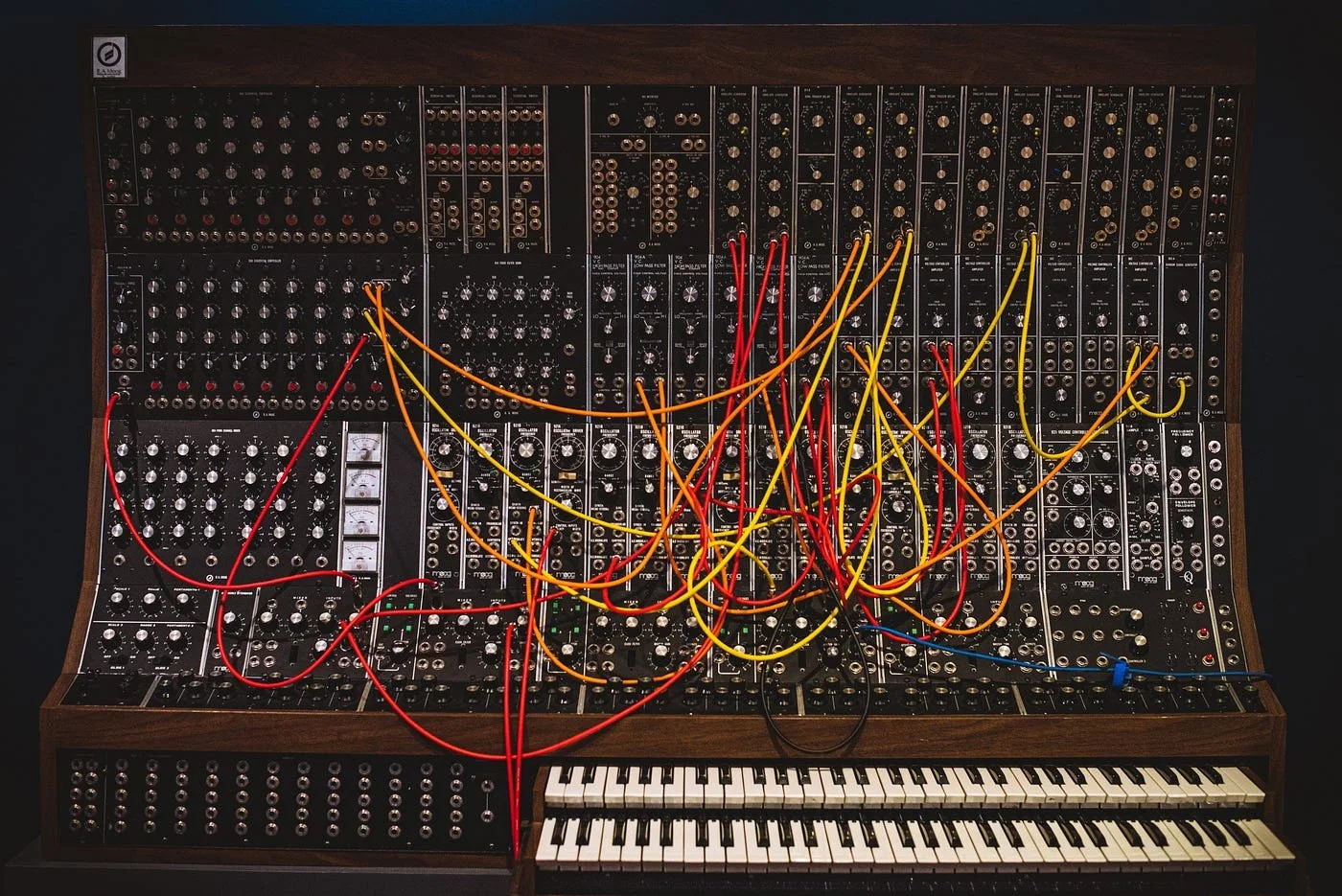
Moog modular synthesizer Image: Ryunosuke Kikuno via Unsplash.
Early synthesizers like the Moog turned musicians into engineers. Instead of just hitting a key, you had to map out signal flow: Input → Filter → Envelope → Output. At its core, a synthesizer doesn't "know" it's making music. It is a Signal Processor.
Component: A visible modular synthesizer acting as central processing unit, with patch cables routing signals between modules
Principle: The "language" it speaks is Control Voltage (CV). This is just electricity that changes in intensity.
Translation: Sensors track where people move and what they touch. That data feeds into the synthesizer. The synth adjusts pitch, timbre, and rhythm. Those changes trigger downstream effects: scent release, visual pattern shifts, lighting intensity.
Experience: You touch a surface. The sound changes. The scent changes. The sand moves. You realize you're not just experiencing the system. You're inside it. You return to the main hall. But now you're different. You notice things you didn't notice before. The infrastructures is invisible until it isn’t.
Intended Effect: You understand feedback loops viscerally, not intellectually. Your choices propagate through every sensory channel.
My closing thoughts
When you document experiences this way: mapping component, principle, translation, experience, intended effect across all eight systems, patterns start to emerge.
You learn which sensory combinations create coherence versus which ones feel forced.
Most importantly: you start seeing them the way they actually function; as one integrated perceptual system.
That's what I'm after. Not just multisensory experiences. Integrated ones. Where the senses are in conversation with each other.
Thank you for thinking with me. This piece is part of Ode by Muno, where I explore the invisible systems shaping how we sense, think, and create.
The quote at the intro is from the book, Systems Intelligence.