experience value = emotional impact ÷ time spent
“Our senses, emotions and muscle memory can be heightened and brought closer to our intellect - in order to encourage the holistic human being to function in all of us.”
The experience economy 2.0
Lately I’ve been noticing a shift in how people measure value. It’s less “Was this worth the price?” and more “Did this actually make me feel something?”
Across fragrance, dining, travel, hospitality… the pattern was the same. The equation that kept coming to mind was:
experience value = emotional impact ÷ time spent.
Basically: the more something moves you in a short window of time, the more valuable it feels.
And the data backs it.
More than half of diners now say they’ll pay extra for a one-of-a-kind experience. And Hilton found that travelers aren’t choosing destinations just because they can; they’re choosing places that answer a “why” for them (Hilton's 2026 Trends Report). Almost like travel has become emotional problem-solving.
So yeah, we’ve officially entered this new chapter what I’m calling Experience Economy 2.0, where brands are realizing they can’t just offer products or services anymore. People want something that hits multiple senses at once. Something they’ll remember. Something that actually rearranges how they feel, even if only for a moment.
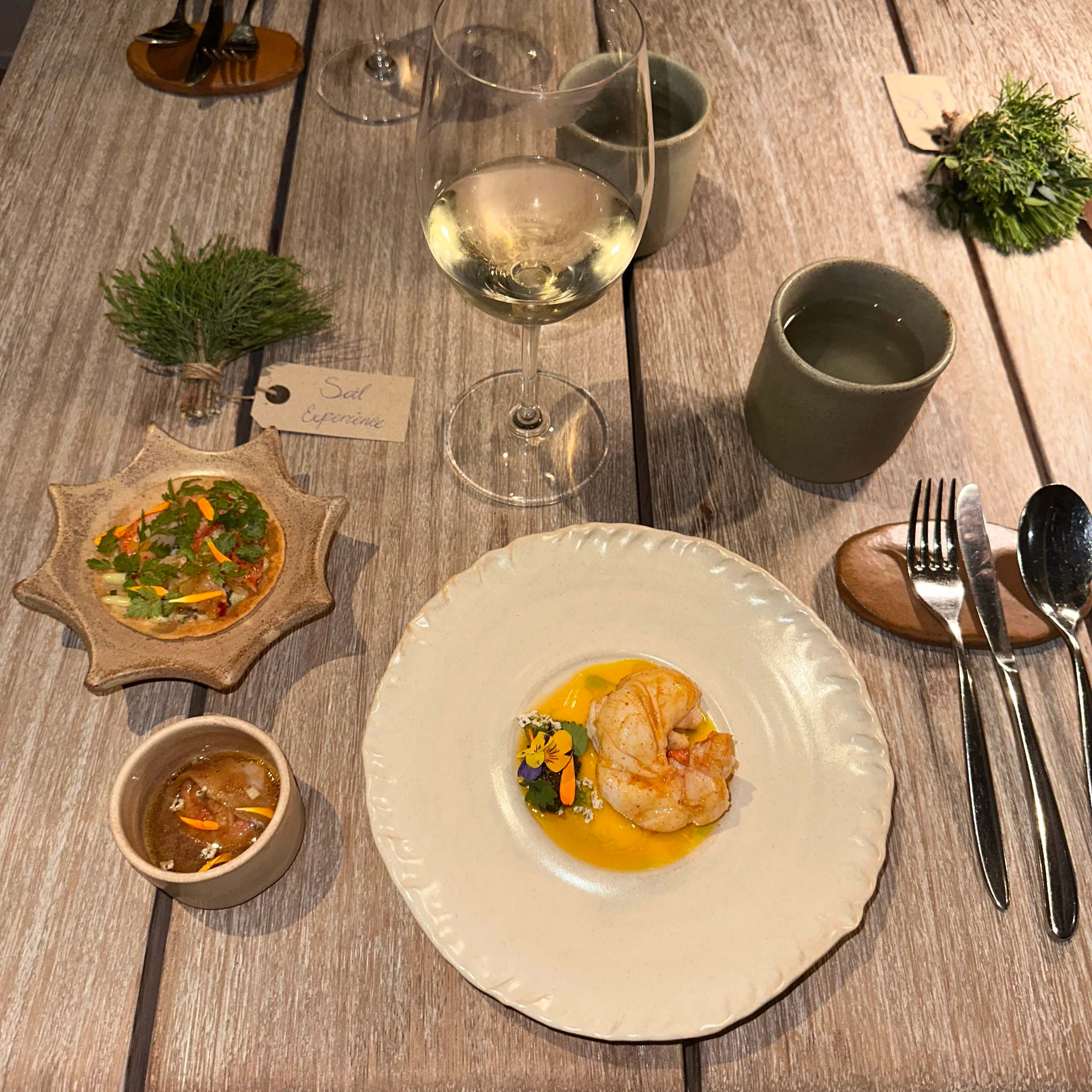
Cover image: My dinner at Soil Restaurant in Athens, Greece. A perfect example of Experience Economy 2.0.
The rise of experiential dining
If you want hard evidence that people are paying for experience, look at restaurants. OpenTable says experiential dining bookings jumped 46% in a single year, which is wild, but also… not surprising (OpenTable 2026 Dining Trends Report).
And what counts as “experiential” keeps expanding.
It’s not just tasting menus or open kitchens (though those are still huge). It’s guest chef takeovers, kitchen parties where you’re basically eating inside the action, chef’s tables where you actually talk to the team, even little workshops where you learn gin-making or regional techniques. Restaurants aren’t just feeding people, they’re hosting them.
What's fascinating is how experiential dining has become analogous to fine dining, not in price or formality, but in philosophy. Fine dining has always been about curation: the pacing, the presentation, the narrative arc of a meal. Now that same intentionality is spreading across the entire restaurant landscape. Fast-casual concepts, neighborhood bistros, even food halls are borrowing from the fine dining playbook: the principle that every touchpoint matters. The goal is the same: create a high-quality, memorable experience. The execution just looks different at every price point.
Dr. Philippe Masset of EHL Hospitality Business School frames this as a fundamental business model shift: "In today's hospitality world, businesses aren't just offering meals—they're delivering experiences. Whether it's a fast-casual spot or a five-star dining destination, restaurants must constantly adapt to meet the rising expectations of increasingly discerning guests." (Hospitality Industry Trends For 2025 - EHL)
And bars are doing the exact same thing. Think about Ashley Sutton’s spots in Asia, they feel like walking into a story. Masset talks about bars becoming “experiential destinations,” and it tracks: narrative wine lists, small mixology classes, spaces designed to literally transport you. “Speakeasies, flair bartending, and storytelling are driving the trend.”
Younger diners are actively seeking "adventure in flavors" and new tastes to discover (af&co. + Carbonate, Innova Market Research). Restaurants are responding with flights, multiple variations of the same item, from spreads and dips to mini entrées, drinks, or dessert trios.
It’s all the same pattern: if it doesn’t engage your senses or give you a story, it just doesn’t land anymore.
Mirror / discover yourself where you are
Travel is probably where this whole shift shows up the clearest. Hilton even has a name for it now: the “whycation” (Hilton's 2026 Trends Report). Basically, people are traveling because it answers something emotional for them.
Hilton’s report says: after years of “more is more,” people want trips that feel intentional. Some want quiet escapes. Some want nostalgic road trips. Others want trips rooted in personal passions. It’s less about the destination and more about what the trip mirrors back to you.
A couple of numbers really stood out to me:
74% of travelers now prefer booking with brands they trust.
And 48% are adding solo days before or after group trips, carving out personal time inside a shared trip.
Hilton’s CEO Chris Nassetta says:
“More than ever, it’s the feeling behind the trip that’s guiding where the journey begins.”
Over the past year, "solo travel" was searched 1.5x more than "travel with kids" (Google Trends). Reddit's r/solotravel community gained over 500,000 members this year. Solo journeys are expected to surpass $1 trillion by 2033 (af&co. + Carbonate Hospitality Trends Report 2026).
Airlines and cruise ships are leaning into surprise with "mystery travel," where the destination isn't revealed until departure, or even arrival (af&co. + Carbonate Hospitality Trends Report 2026). A Booking.com study found that 52% of travelers would be interested in reserving a trip where the destination remained a mystery.
The value of feeling more in less time
Experience Value = Emotional Impact ÷ Time Spent makes everything make sense. People aren’t looking for longer experiences; they’re looking for denser ones. A two-hour dinner that leaves you thinking about it for days feels way richer than a four-hour meal that’s just… fine.
Once you see that pattern, it shows up everywhere.
OpenTable says 61% of Americans expect dining out to feel more like a special occasion next year.
And in travel, Hilton is seeing this “Hushpitality” trend: people choosing destinations specifically to relax. Places where the value comes from calm, not activity.
Beauty is doing the same thing. Mintoiro calls it “Holistic Self-Care,” which is really just the industry realizing that people want products that soothes, lifts, and changes mood (Mintoiro Beauty Trend Forecast 2026).
Even the creator economy is built on this math now. Brand trips aren’t just marketing, they’re engineering emotional moments. Two or three days of high-density experiences, paced and sensory-rich, because brands know creators need something memorable enough to translate into content. The experience has to hit hard and fast to feel shareable.
You can see it in the sensory layering too: textured packaging, pop-ups that feel like mini worlds, fragrance installations you move through instead of just smell. The question has changed from “What does this do?” to “How does the whole thing make me feel?”
Across categories, it’s the same equation at work: high emotional payoff in a small amount of time.
Using data to curate high-value experiences
What surprised me most, looking across all these sectors, is how clear the pattern is: technology can enable an experience, but it can’t replace the human part that actually makes it meaningful. Dr. Meng-Mei Maggie Chen from EHL said: "The future and higher purpose of hospitality is its people-centric focus, emphasizing the pivotal role of social connections and human interaction" (Hospitality Industry Trends For 2025 - EHL).
And honestly, that’s the paradox of Experience Economy 2.0. We have all this digital infrastructure, AI personalization, data-driven targeting… but the entire purpose is to create moments that feel more human, not less.
You feel this in small ways:
the restaurant that already knows your dietary quirks,
the hotel app that lets you skip the friction of check-in,
the beauty brand that recommends exactly the texture you prefer.
That’s the paradox I keep coming back to:
the better AI gets, the more human we want our experiences to feel.
Deliver maximum emotional impact in minimum time
For anyone working in the lifestyle space (hospitality, dining, beauty, travel), the implications are actually pretty simple once you see the pattern.
First, audit every touchpoint for sensory opportunity.
People don’t just interact with your product; they sense it. Texture, lighting, scent, pacing, ambient sound, every detail is either creating emotional resonance or quietly flattening it.
Second, design for meaning, not just function.
The “why” is doing most of the heavy lifting now. Travelers want a feeling they’ll remember, not just a destination. Diners want a moment worth recalling, not just a plate of food. If the emotional intention isn’t clear, the experience won’t land.
Third, treat experience like architecture.
Space design, service choreography, sensory programming are core competencies. And frameworks like the Ode Experience model can help you understand which senses they’re shaping, and why those choices matter.
Fourth, optimize for emotional efficiency.
This is the heart of Experience Value: the goal isn’t to keep people longer, it’s to move them deeper. Density of feeling is more valuable than duration of exposure. A two-minute moment can outperform a two-hour visit if it hits the right sensory and emotional notes.
And finally, close the feedback loop.
People are constantly signaling what resonates, what they photograph, share, revisit, talk about. Treat that as a data loop, not a comment box. Experiences are tunable systems. So iterate like this.
The brands/groups/people that thrive in Experience Economy 2.0 will be the ones that understand:
the future belongs to whoever can deliver maximum emotional impact in minimum time.
Sources
af&co. + Carbonate 18th Annual Hospitality Trends Report 2026
Hilton's 2026 Trends Report: The Rise of the Whycation
Top Restaurant Trends in 2026 - OpenTable / Dining & Consumer Insights
Beauty Trend Forecast 2026 - Jennifer Carlsson / Mintoiro
Hospitality Industry Trends For 2025 - EHL Hospitality Business School
Thank you for thinking with me. This piece is part of Ode by Muno, where I explore the invisible systems shaping how we sense, think, and create.
The quote at the intro is from the book, Systems Intelligence.